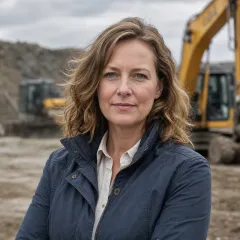
If you buy construction equipment and site supplies for a living, you know the job is never just about the machine. I'm office administrator for a 140-person construction and grounds-maintenance contractor in the UK, and since 2020 I've been responsible for roughly £1.1m a year in purchase orders across machines, parts, and consumables. The questions I get from operators, project managers, and finance fall into two groups: some about heavy kit, and some about things that sound too small to matter, like paint rollers or a Subaru truck that has no business being on site. These are the FAQs I keep giving.
What Should I Check When Searching JCB Excavator For Sale UK?
Start with the machine you need, not the price that catches your eye. I learned this in 2020, my first year handling equipment purchases. I found a used JCB tracked excavator that looked excellent in photos and cost a few thousand below dealer listings. The seller wasn't an approved JCB dealer and couldn't provide more than a handwritten receipt for the last service. Four months later the machine lost hydraulic pressure. A new pump and labor wiped out most of what we saved.
That is why I now treat JCB excavator for sale UK as the beginning of a checklist. Check engine hours, service records, pins and bushes, undercarriage wear, and whether the machine has been on a dealer forecourt or a private yard. If the sellers won't let you test it or allow an inspection, walk away. Plant Trader and Machinery Trader dealer listings in early 2025 give you a realistic budget range; verify current prices because the market moves quickly.
Also decide which category you need. A JCB 19C or 8016 mini excavator suits tight residential and utility work. A JCB 3CX backhoe loader is more of a do-everything machine. A full-size tracked excavator does heavier digging but costs more to transport and maintain. Comparing the right class is half the battle.
Where Is the JCB Forklift Battery Located?
If you searched JCB forklift battery location because a machine won't start, I understand the frustration. There is no one generic spot, because JCB builds engine-powered and electric machines with completely different body layouts.
On many JCB Teletruk models and smaller electric forklift-style machines, the main battery is underneath or just behind the operator seat. It normally sits in a steel tray under a cover; you may need to flip the seat cushion, release a lever, or remove a couple of bolts. On diesel JCB forklifts and telehandlers, the battery you need is more often a normal 12V starter battery. Look behind the engine side panel, inside the counterweight compartment, or under the rear engine cover rather than expecting a huge traction battery box.
Check the machine decal and operator handbook before buying anything. I didn't do that once, assumed the old 12V battery size would fit, and returned ours to the site with the wrong terminal layout. That is an easy way to lose an hour and look unprofessional. When you find the battery, disconnect the negative terminal first. If it is a large electric forklift battery, charge it in a ventilated area and follow the charger instructions.
If the answer is not obvious, find the model plate and search that exact machine reference. A short video that says battery under the seat will not help if you have a diesel tool carrier. Get the manual.
Should a Paint Roller Really Be on a Procurement List?
In a company that buys excavation machinery, a paint roller sounds like an item for reception to handle. But when your own crews do finishing work, paint rollers are operational consumables, and the cheapest option is usually not the cheapest once labor is included.
In my first year of purchasing, I ordered a bulk pack of synthetic rollers without reading the paint specification. The crew was applying a solvent-based coating, and the rollers started to soften and shed fibers. They had to stop the job, strip the section, and redo it. That mistake cost us more in call-out time and wasted paint than a premium roller would have cost for a whole year.
For water-based emulsion, a medium-pile synthetic roller is usually fine. For solvent-based or epoxy coatings, use a solvent-resistant roller, and for oil-based gloss you want a shorter pile. This is a small version of the quality rule I apply to everything: people judge your company by what they receive, so the roller needs to match the coating, not just the budget.
Why Would We Keep a Subaru Truck in a Construction Fleet?
I asked the same question when I first saw a Subaru truck on the vehicle insurance list. It looked too small and too road-oriented for a construction company. Then I watched how much the workshop used it: collecting filters, delivering samples, moving welding leads, carrying a few paint rollers, and running between sites. That is a lot of journeys where sending a heavy hauler is pointless.
A Subaru truck can earn its place if you treat it like what it is, a light utility vehicle. Respect its payload rating. I found that out when one of our teams loaded a pallet of aggregate onto the bed and took it across soft ground. The suspension bottomed out, and the repair bill turned the free trip into a lesson. Use it for light loads and fast trips, not as a substitute for a JCB machine.
The lesson for a buyer is simple: a vehicle belongs on the fleet because it does a job efficiently, not because it looks impressive on the yard.
How To Operate a Forklift Safely When You Are New to It
Anyone can search how to operate a forklift and find a video in seconds. The realistic answer is that driving is easy, lifting safely is not. Forklifts and telehandlers all handle differently, and no video can teach you how a loaded machine stops and steers.
Before you get on any machine, do a basic check: condition of the forks, tires or tracks, leaks under the mast, horn, lights, steering, and brakes. If you are using a JCB telehandler rather than a standard counterbalance forklift, the control layout may be different, so read the pictograms on the machine first.
- Know the lifting capacity from the rating plate. The plate on the machine is not a guide, it's the limit.
- Approach the load squarely and lift it only after the forks are fully under the pallet. Tilt the mast back so the load rests against the backrest.
- Travel with the forks about 100-150 mm above the ground. If the load blocks your view, travel in reverse.
- On slopes, keep the load on the uphill side. Drive forward when going uphill with a load and reverse down the slope.
- Use a spotter when stacking racks or unloading from a delivery vehicle.
Sit in the seat, fasten the seatbelt if fitted, and remember that in the UK the Health and Safety Executive's L117 code of practice is the starting point for training. An accredited course is not paperwork; it is the difference between someone who can move a forklift and someone who can operate one. I send every new starter on one before they touch our machines, no exceptions.